SAVE 15% . USE CODE: HOLIDAY15


Varsity Jackets Around the World: How Different Cultures Have Adopted the Style

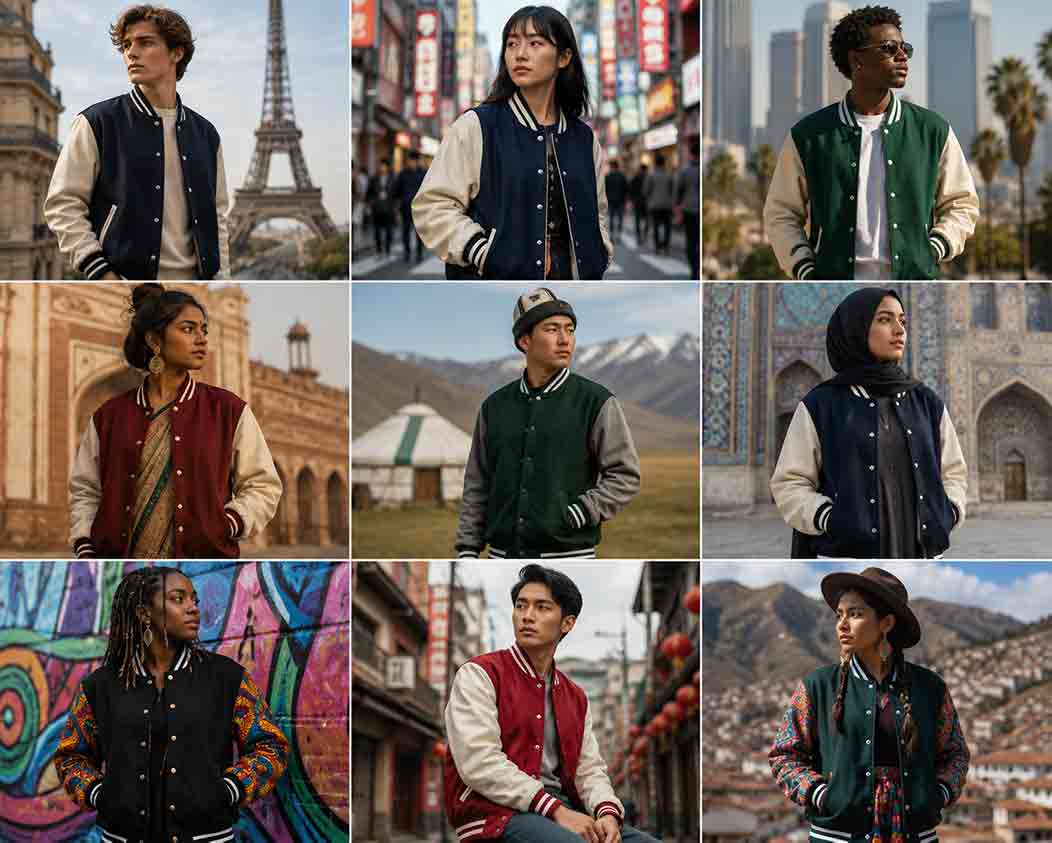
A garment born in 1865 on the Harvard baseball diamond now sells in streetwear boutiques from São Paulo to Seoul. That journey — spanning continents, subcultures, and centuries — says more about how cultures absorb, resist, and remake American symbols than almost any other piece of clothing.
The varsity jacket, or letterman jacket, started as a practical reward: a wool sweater stitched with a single letter, handed to athletes as a badge of achievement. Today, the global coats and jackets market is projected to generate approximately $110 billion in revenue in 2024, with Asia-Pacific emerging as the fastest-growing region. The varsity jacket is far from a footnote in that number — it is one of the style’s most influential drivers.
But the more interesting story isn’t the market data. It’s what happens when a deeply American symbol crosses a border. In Japan, it fused with postwar occupation history and traditional silk embroidery to produce the sukajan, a garment so culturally loaded it earned Yakuza associations and later graced Louis Vuitton runways. In South Korea, K-pop idols transformed it into a precision style statement that moves seamlessly from stage to airport to street. In Latin America, it absorbed hip-hop’s energy and became a canvas for local identity. In Europe, it arrived through American cinema, hip-hop exports, and football crossover culture.
This article traces those journeys — region by region, subculture by subculture — to show how one garment became a global language, and what each culture chose to say with it.
At a Glance: Four Jackets, Four Cultures
Before diving into each region’s story, this comparison shows how the same silhouette diverges once it crosses a border — different materials, different symbols, different contexts, same recognizable form.
| 🇺🇸 American letterman | 🇯🇵 Sukajan | 🇰🇷 K-pop varsity | 🇪🇺 European luxury | |
|---|---|---|---|---|
| Est. | 1865 | 1945–52 | 1990s | 2000s |
| Symbol | Athletic merit | Rebellion, identity | Idol cool, fandom | Luxury streetwear |
| Key mark | Chenille letter | Dragon / tiger motifs | Brand logo patch | House monogram |
| Materials | Wool + leather | Satin + rayon | Mixed tech fabrics | Cashmere, suede |
| Fit | Classic / boxy | Relaxed | Slim / tailored | Structured |
| Context | Schools, teams | Street, runway | Stage, airport, street | Runway, high fashion |
Where It All Began: The American Letterman Jacket
Before any culture could reinterpret the varsity jacket, the original had to take shape.
The story starts at Harvard University in 1865, when the baseball team introduced the “letterman” concept: players wore heavy wool sweaters embroidered with an “H” to signify membership on the varsity team. By 1875, Harvard’s football team had adopted the same tradition, further cementing the garment’s association with elite athletic achievement. The letter wasn’t just decorative — it was earned. Coaches decided who received it. Players wore it as visible proof of their status within the school’s social hierarchy.
By the 1930s, the silhouette had evolved from a pullover sweater into the recognizable jacket form: a wool body, leather sleeves, ribbed cuffs and collar, snap-button closure, and a chenille letter sewn onto the chest. This wasn’t purely aesthetic — the combination of warm wool and durable leather made practical sense for athletes spending long hours outdoors in variable weather.
The post-World War II era accelerated the jacket’s cultural weight considerably. As higher education expanded rapidly and college life became deeply embedded in American culture, varsity jackets followed. High schools adopted the tradition, embedding the jacket into teenage identity across the country. Then Hollywood multiplied its reach: films and television of the 1940s and 1950s repeatedly featured the jacket on leading male characters, associating it with youth, ambition, and a certain kind of effortless social dominance. By the 1950s, it had become a major cultural artifact, its frequent appearances in American teen films associating it with rebellious youth and the cool factor that high school athletes embodied.
The jacket’s transition from campus award to fashion statement accelerated through two key moments. First, hip-hop: by the 1980s, artists like Run-D.M.C. had adopted varsity jackets as streetwear, breaking the garment’s exclusive association with athletic achievement and making it accessible to anyone who wanted to signal cool. Second, the rise of streetwear brands in the 1990s: labels like Stüssy and Supreme reimagined the jacket with bold, non-traditional graphics, pulling it firmly into urban fashion culture.
From that foundation, the jacket traveled outward — and each region it reached had its own story to tell.
Japan: The Sukajan and the Art of Cultural Fusion
No country transformed the varsity jacket more profoundly or more beautifully than Japan — and the circumstances of that transformation were anything but ordinary.
The story begins in postwar occupied Japan, specifically around the U.S. Fleet Activities base in Yokosuka, between 1945 and 1952. American servicemen stationed there began commissioning local Japanese craftspeople to embroider their military jackets and, later, new jackets built from scratch, with imagery that captured their time in Japan: tigers, dragons, eagles, cherry blossoms, Mount Fuji. The silhouette was based directly on the classic American baseball and varsity jacket popularized by 1930s varsity teams — complete with contrasting sleeves and ribbed cuffs. But the embroidery was unmistakably Japanese, executed in traditional techniques using satin and silk fabric.
These jackets became known as sukajan — a name believed to combine the suffix from Yokosuka with “jan,” the Japanese slang for jacket derived from the English word “jumper.” Soldiers brought them home as souvenirs. Because each piece was individually commissioned and hand-embroidered, no two original sukajan were identical. By the 1950s, Minato Shōkai (now operating as Tailor Toyo) held approximately 95% market share in supplying these jackets, making it the driving force behind Japan’s first postwar fashion exports.
The sukajan’s journey through Japanese society is a study in how garments absorb political meaning. As the sukajan grew popular in America, Japan was simultaneously undergoing its own cultural negotiation — the “ametora” effect, a fascination with American clothing and pop culture that publications like Popeye magazine spread throughout the 1950s to 1970s. Some Japanese youth embraced American prep style wholesale. Others found the sukajan a more pointed choice: built on an American silhouette but covered in Japanese imagery, it allowed wearers to make a statement of cultural identity rather than straightforward cultural adoption. Working-class Japanese teenagers in the 1960s adopted the sukajan as a symbol of rebellion and resistance against the Americana-obsessed ametora trend.
That rebellious association deepened to the point of societal disapproval: the sukajan became linked with “Yankee culture,” delinquent fashion, and eventually the Yakuza. In context, that disapproval only proved the garment’s power. As one assessment noted, the sukajan’s association with transgression served as proof that it was a “symbol of freedom.”
The jacket’s cultural rehabilitation came in waves. In the 1960s and 1970s, rock stars like Mick Jagger wore sukajan while on tour, introducing the style to Western audiences. Then came the mid-2010s revival: the sukajan experienced a massive spike in popularity among high fashion retailers and celebrities, with Menswear Style magazine declaring it the “defining fashion item” of 2017. Drake, Kanye West, and Harry Styles were photographed wearing variations of the style. Designers like Louis Vuitton reinterpreted the silhouette with light floral prints, while Japanese streetwear label Neighbourhood replaced traditional embroidery with hand-stitched detailing. Yoshiji Yamamoto brought his minimalist signature to the form. Today, the Tokyo 2020 Olympic Games even produced an official sukajan that fused the Olympic logo with dragon and tiger embroidery.
What Japan did with the varsity jacket is arguably the most complete cultural transformation in the garment’s history. It took an American form, filled it with Japanese craft and symbolism, embedded it in Japan’s specific postwar history, and sent it back into the world as something genuinely new. The sukajan is no longer “a Japanese version of the varsity jacket” — it’s a distinct garment category that happens to share a silhouette.
South Korea: K-Pop Turns the Varsity Jacket Into a Style System
If Japan’s contribution to varsity jacket culture is rooted in craft and postwar history, South Korea’s is rooted in performance — the performance of identity on the global stage that K-pop has made into a precision art.
The varsity jacket’s arrival in Korean fashion is inseparable from the development of K-pop itself. K-pop fashion emerged during the late 1990s, with first-generation groups wearing oversized jackets with baggy pants and colorful streetwear that reflected the hip-hop fashion of their era. That aesthetic laid the groundwork for a jacket-centric culture that would define K-pop styling for decades. As K-pop moved through its second and third generations — through Big Bang, 2NE1, BTS, EXO, and BLACKPINK — the varsity jacket evolved alongside it. Idols began wearing Gucci, Chanel, and Dior, blending streetwear with luxury fashion and experimental design. The varsity jacket sat perfectly at that intersection: streetwear by origin, luxurious in its Korean reinterpretation, and infinitely versatile in its styling potential.
Unlike its American ancestor, the K-pop varsity jacket is not primarily about athletic achievement. It functions as a versatile statement piece that moves seamlessly between stage, airport, street, and casual wear. It carries the energy of youth culture, rebellion, teamwork, and cool effortlessness that defines Korean popular fashion. University varsity jackets from prestigious Korean institutions like Yonsei have also become culturally significant in K-pop adjacent fashion, blending academic prestige with the idol lifestyle aesthetic — but without the strict “you earned this through sports” gatekeeping of the American original.
The K-pop vector has given the varsity jacket one of its most powerful modern amplification mechanisms: global fandom. When BTS members are photographed wearing a specific varsity jacket in an airport, that image circulates to tens of millions of followers across social media within hours. Fan communities document, replicate, and debate every styling detail. The result is a demand loop that is genuinely global in scope and strikingly fast in execution. Idols’ visibility accelerates trends, turning varsity jackets into aspirational pieces embraced by global audiences almost simultaneously.
Korean designers have also contributed to the garment’s evolution in more structural ways, producing slim-fit silhouettes that differ noticeably from American and European interpretations, and incorporating technical fabrics alongside traditional wool-and-leather combinations. The K-pop varsity jacket is typically more tailored, more deliberately styled, and more conscious of its layering possibilities than its American predecessor.
South Korea’s adoption of the varsity jacket demonstrates something important about how cultural exports work in the digital age: the K-pop industrial complex doesn’t just wear fashion trends — it amplifies, documents, and distributes them to a pre-built global audience at a speed that no previous fashion ecosystem could match.
Europe: Football Crossovers and High Fashion Reinterpretations
Europe’s relationship with the varsity jacket followed a different path: it arrived primarily through American cinema and music, gained traction through streetwear in the 1990s, and has recently undergone a striking reinvention through the intersection of American fashion and European football culture.
The early European adoption followed the transatlantic flow of American cultural exports. Hollywood films of the 1950s brought the varsity jacket to European audiences as a symbol of American youth. Hip-hop culture in the 1980s gave it a new wave of visibility. Streetwear brands provided a third wave in the 1990s and 2000s. But European fashion culture, with its deep traditions of tailoring and its skepticism of overt Americana, often held the varsity jacket at arm’s length — cool to observe, occasionally compelling to wear, but not quite native.
What changed that dynamic, at least in part, was football. The varsity jacket’s rise in global football culture represents one of the more surprising stylistic convergences of recent years. Collaborations between legendary clubs — Arsenal, AC Milan — and fashion labels like OFF-WHITE and Dsquared2 have brought the varsity jacket format directly into football’s visual language. Football stars wearing varsity-style jackets at press conferences, on social media, and in brand partnerships have normalized the style for audiences in the UK, Italy, Germany, and beyond.
European luxury fashion houses have played an equally important role, though with a different effect. Louis Vuitton, Gucci, Acne Studios, and Balenciaga have all produced varsity jacket reinterpretations, updating the classic silhouette with premium materials, intricate detailing, and modern colorways. Nigo’s debut collection for Kenzo featured the jacket prominently. Acne Studios offers versions in vibrant colors like emerald green and magenta, stripped of excessive ornamentation. These interventions have secured the varsity jacket’s place in European high fashion without fully domesticating it — it still carries an American inflection that European designers often keep visible as part of the garment’s appeal.
Philipp Plein’s approach is instructive: he has explicitly merged the varsity jacket format with oriental cultural references, adding patches inspired by Chinese tradition to create a kind of stylistic collage. The result is a garment that makes its international DNA visible rather than erasing it.
Europe’s varsity jacket story is ultimately one of mediation: the continent received the garment through American cultural exports, filtered it through its own fashion sensibilities, and is now involved in redistributing a more complex, multi-referential version of the style back into global circulation.
Latin America: Hip-Hop Roots, Local Identity, and Urban Energy
Latin American streetwear’s relationship with the varsity jacket is newer in its formal articulation but deep in its cultural logic. The region’s streetwear scene has grown into what analysts describe as a powerful cultural force driven by youth identity, digital influence, and community creativity — and the varsity jacket is a natural fit for that energy.
The initial point of entry was hip-hop. As American hip-hop culture traveled through the Americas in the 1980s and 1990s, it brought the varsity jacket with it, embedded in the visual codes of artists whose music was being consumed across Brazil, Mexico, Colombia, Argentina, and beyond. The jacket’s association with urban cool, team identity, and expressive personalization resonated in cities where young people were similarly navigating questions of belonging, resistance, and self-expression.
Brazil’s streetwear scene demonstrates how that foundation developed. Deeply intertwined with music, race, and urban identity, Brazilian streetwear evolved from the hip-hop collectives of São Paulo and the cultural energy of Rio de Janeiro. Brands like Lab Fantasma — founded by rapper Emicida in 2009 — exemplify the fusion of fashion and activism that defines the region’s most influential streetwear. The varsity jacket, as a customizable, patch-friendly, identity-signaling garment, fits naturally within that framework. Local brands have increasingly used the varsity silhouette as a canvas for heritage imagery, community references, and political statements that have nothing to do with American high school sports.
Mexico and Colombia present similar patterns: varsity jackets adopted not as American nostalgia but as raw material for local expression. The customizable nature of the jacket — its patches, its chenille letters, its two-tone construction — makes it an unusually malleable medium. A Mexican brand can replace the varsity letter with Aztec calendar imagery. A Colombian streetwear label can use the back panel as a canvas for political art. The silhouette stays recognizable; the content becomes entirely local.
This dynamic reflects something broader about how Latin American fashion absorbs external influences: not passively, but through what designers and cultural critics describe as a dialogue between heritage and urban expression. The varsity jacket arrives with American cultural freight attached, and Latin American wearers selectively keep some of that freight while unloading the rest.
The Middle East and South Asia: Streetwear’s New Frontier
The varsity jacket’s penetration into Middle Eastern and South Asian fashion markets is more recent, and its cultural dynamics are still actively forming — but the growth is significant.
In cities like Dubai, Riyadh, and Karachi, the varsity jacket arrived primarily through two vectors: global streetwear brands and K-pop cultural influence. The region’s young, digitally connected consumer base has absorbed both simultaneously, creating a demand for the garment that exists partly as global fashion participation and partly as a signal of cultural cosmopolitanism. Wearing a well-chosen varsity jacket in these markets communicates awareness of global trends while leaving room for local styling choices.
Customization has become particularly significant in these markets. The jacket’s capacity to carry personal or community-specific imagery — patches representing cities, religious symbols interpreted through a streetwear aesthetic, bilingual text combining Arabic or Urdu script with English lettering — allows wearers to make the garment visibly their own rather than simply wearing a piece of American or Korean fashion.
The global casualwear market, with Asia-Pacific holding 41.51% market share as of 2024, tells part of this story quantitatively. But the more interesting shift is qualitative: young consumers in these regions are not just buying the varsity jacket as imported fashion — they are beginning to use it as a medium for articulating identity that is simultaneously global and local.
What Makes the Varsity Jacket So Universally Translatable?
After tracing the varsity jacket’s journey across continents and cultures, a structural question emerges: why this garment? What makes the varsity jacket, specifically, so amenable to cultural reinterpretation?
Several properties stand out.
The silhouette is legible but not specific. The combination of contrasting sleeves, ribbed cuffs and collar, and snap-button closure creates an instantly recognizable form — but that form doesn’t carry intrinsic cultural meaning the way, say, a kimono or a kente cloth does. It’s a recognizable shape waiting to be filled with content.
The front and back panels function as canvases. The chenille letter, the team patches, the back embroidery of a sukajan — these are all variations on the same principle: the jacket offers flat, visible surfaces designed for messaging. That infrastructure for personalization is built into the garment’s original logic. Whatever a culture wants to say, it has a natural place to say it.
Its associations are aspirational rather than prescriptive. The varsity jacket originally signified athletic achievement, then youthful cool, then street credibility, then luxury. None of these associations is so culturally specific that they block reinterpretation. A South Korean idol wearing a varsity jacket isn’t claiming to have played American high school football — they’re drawing on the jacket’s broader connotations of energy, team belonging, and achieved status.
It accommodates both mass market and luxury positioning. The same silhouette that appears in a fast-fashion retailer’s $40 offering also appears in a $2,000 Louis Vuitton interpretation. That range means the jacket can participate in conversations about aspiration at virtually every price point.
Customization is native, not retrofitted. Unlike many garments that require structural modification to feel personal, the varsity jacket was designed from the beginning to be customized. That invitation to personalization means every culture that adopts it already has a built-in mechanism for making it their own.
Luxury Fashion’s Global Democratization of the Style
One of the more counterintuitive aspects of the varsity jacket’s global spread is the role luxury fashion has played in it. Normally, luxury houses are associated with exclusivity — removing garments from mass circulation rather than spreading them. With the varsity jacket, the dynamic has worked differently.
When Nigo wore a varsity jacket for his debut collection at Kenzo, or when Pharrell Williams’ Louis Vuitton menswear models appeared in varsity-adjacent pieces, it sent a signal to international fashion audiences: this garment is not just American nostalgia or streetwear basics. It is a legitimate vehicle for high fashion. That legitimization filtered downward through the fashion ecosystem, encouraging designers in Korea, Japan, Brazil, and elsewhere to treat the form seriously rather than as a casual reference.
Designers like Yoshiji Yamamoto approaching the varsity jacket with a minimalist signature, or Acne Studios offering clean versions in unexpected colorways, created what might be called “designer permission” — a signal that the garment was open to serious reinterpretation across aesthetic traditions. OFF-WHITE adopted the varsity jacket as a style manifesto, marking it as a site of intersection between streetwear, art, and cultural commentary.
The global streetwear industry is expected to reach $257.67 billion by 2030, growing at a CAGR of 4.17%. The varsity jacket, positioned at the intersection of streetwear’s energy and high fashion’s ambition, is well-placed to grow within that market — not as a single American product but as a globally distributed form that different cultures continue to fill with their own meaning.
The Varsity Jacket as a Map of Cultural Globalization
The varsity jacket’s story around the world is not a story of American cultural imperialism — it’s more nuanced and more interesting than that. It’s a story of how cultures selectively adopt, resist, and transform external forms to express something authentic about themselves.
Japan took the American silhouette and filled it with traditional Japanese craft and postwar history, producing the sukajan — a garment that now stands as one of the great examples of cross-cultural creation in fashion. South Korea took the same silhouette and embedded it in K-pop’s global performance machinery, making it a vehicle for soft power projection at a scale American college athletes could never have imagined. Latin American streetwear took it as raw material for urban expression rooted in local identity and resistance. European luxury fashion took it and subjected it to the continent’s traditions of formal elegance and design precision.
None of these adoptions replaced the American original. Harvard’s 1865 letterman tradition is still visible in the silhouette, the ribbed cuffs, the contrasting panels. But it has become one layer in a garment that now carries the accumulated meaning of multiple cultures’ negotiations with it.
That accumulation of meaning is what makes the varsity jacket unusual. Most garments either remain culturally specific or become so generic that they carry no meaning at all. The varsity jacket has done something rarer: it has remained recognizable while absorbing new cultural content with each adoption, becoming denser with meaning rather than emptier.
When you see a hand-embroidered sukajan from Tailor Toyo, or a slim-fit K-pop varsity from a Seoul streetwear label, or a Brazilian brand’s version with heritage embroidery across the back, you’re seeing a record of those negotiations — a garment that has become, in a meaningful sense, a map of how fashion travels and transforms in the modern world.
Conclusion
The varsity jacket started as a wool sweater with a letter sewn onto it. What it became — in Japan’s postwar workshops, on Seoul’s idol stages, in São Paulo’s hip-hop scenes, on Paris and Milan runways — is a global language of belonging, achievement, and identity.
Understanding that journey matters not just as fashion history but as cultural literacy. When a garment this specific travels this far and transforms this profoundly, it reveals something about how cultures actually interact: not through passive absorption but through active translation, where what gets borrowed is the structure, and what gets added is everything that makes it mean something to the people wearing it.
The best way to understand a culture’s relationship with the varsity jacket is to look at what they put on the back panel. The silhouette is always recognizable. The content is always theirs.
Frequently Asked Questions
What makes varsity jackets popular around the world?
Their mix of sporty style, comfort, and cultural symbolism makes varsity jackets appealing across different countries and fashion scenes.
How have different cultures adapted varsity jackets?
Many cultures add local fashion trends, colors, embroidery, and streetwear influences to make the jackets unique to their region.
Are varsity jackets only connected to American schools?
No. While they started in American schools, varsity jackets are now worn globally as fashion statements by people of all ages.
Why are varsity jackets popular in streetwear fashion?
Their bold designs, oversized fits, and customizable patches make them a favorite in modern streetwear and urban fashion.
Can varsity jackets be customized for different cultures?
Yes. People often personalize them with local symbols, artwork, team logos, or cultural patterns to reflect their identity and style.
Read more: Personalizing a Letterman Jacket: Names, Numbers, and Nicknames — What’s Allowed?
Read more: What Is a K-Pop Style Varsity Jacket? A Guide to the Trend Dominating Korean Fashion