SAVE 15% . USE CODE: HOLIDAY15


Designing a Varsity Jacket That Works for Multi-Sport Athletes

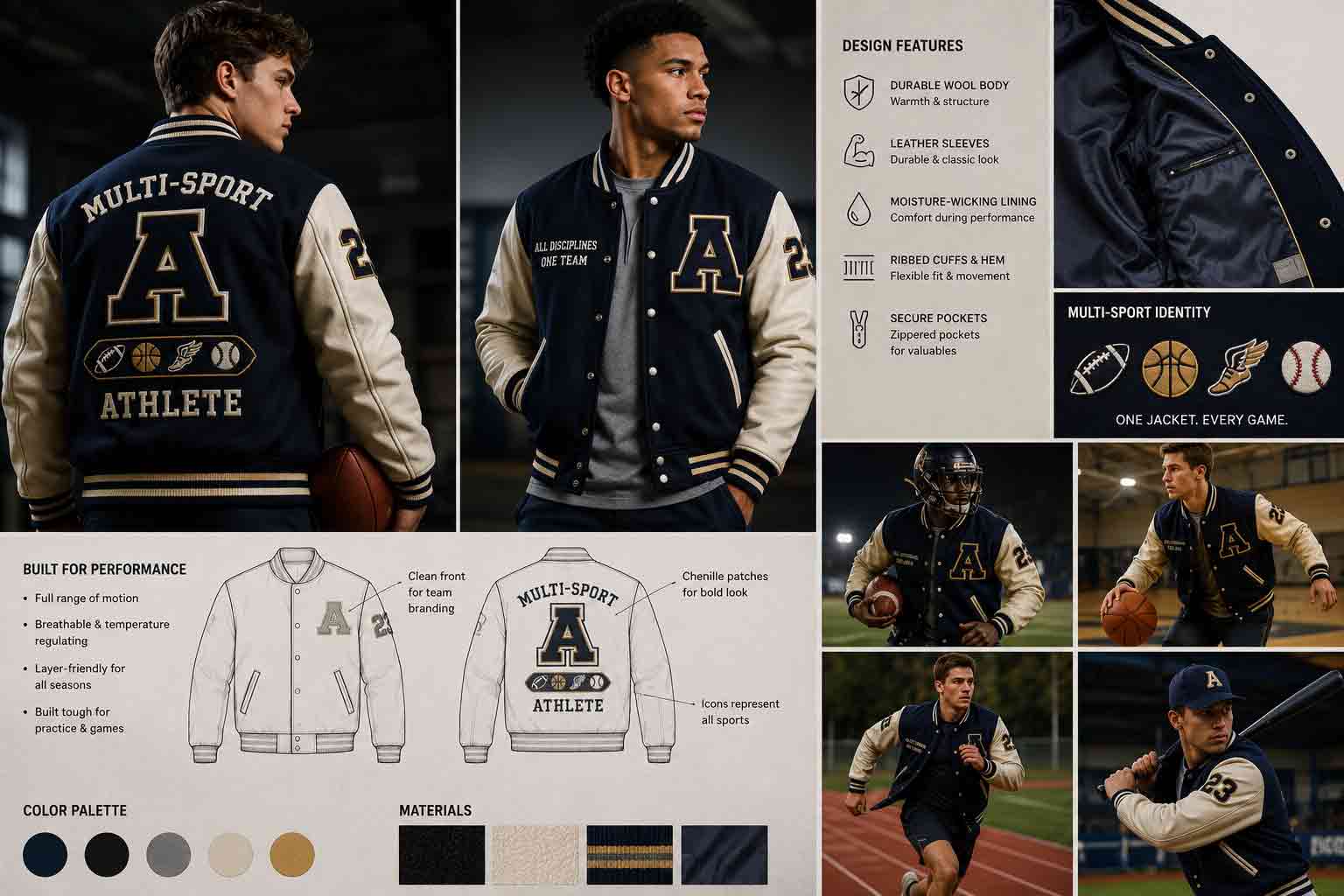
Quick answer: A jacket built for multi-sport athletes has to solve four competing problems at once: moving sweat off the skin, regulating heat across wildly different exertion levels, letting the arms and shoulders move through a full range of motion, and surviving abrasion from different equipment and surfaces. No single fabric or cut does all of this by itself, which is why the best multi-sport jackets are engineered as layered systems with articulated patterning rather than a single “one and done” garment.
The Jacket Has to Outlast the Season, Because the Athlete Doesn’t Stop
More than 8.2 million students competed in U.S. high school sports in 2024–25, an all-time record, and the number keeps climbing even as single-sport specialization gets louder headlines.This week’s release of the 2024-25 NFHS High School Athletic Participation Survey indicated that more than 200,000 additional students were involved in high school sports than the previous year, which continues a remarkable recovery from the pandemic. A meaningful share of those students aren’t single-sport specialists. They’re playing football in the fall, wrestling or basketball in the winter, and track or baseball in the spring — and in the 2022 NFL Draft, 233 of the 262 players selected had participated in multiple sports in high school, with nearly 45 percent having played three or more sports. Multi-sport participation isn’t a niche case for a varsity jacket program to accommodate. It’s close to the norm.
That reality creates a design problem most jacket orders never solve. A jacket built around one sport’s calendar — heavy wool for a fall football roster, for example — is the wrong garment for a track athlete layering it over a warm-up in April, or a wrestler who needs it to survive a gym bag for four months straight. Get the material, fit, and construction choices right, and one jacket can genuinely represent a student’s whole athletic career. Get them wrong, and the school ends up either compromising on durability or asking multi-sport kids to buy more jackets than their single-sport teammates.
This guide breaks down the decisions that actually matter — body fabric, sleeve material, lining, fit, and patch durability — from the specific standpoint of an athlete who will wear the jacket across at least two very different sports seasons a year.
Why “One Jacket, One Sport” Doesn’t Work Anymore
The classic varsity jacket wasn’t designed with cross-season durability in mind, because it wasn’t originally designed for in-season wear at all. The garment traces back to 1865, when Harvard’s baseball team began stitching a large “H” onto thick wool sweaters awarded to top performers.The first time a letterman jersey was ever worn was by the Harvard University baseball team in 1865, consisting of a very heavy wool sweater, and legend has it that the players themselves decided to embroider a large “H” in the center. The leather-sleeve, wool-body combination that people now think of as “the” varsity jacket didn’t appear until decades later. In 1930, athletes began demanding heavier clothing to combat the cold, and leather sleeves and buttons were added to the wool jersey, with the letter moving to one side as the letterman jacket became a status item within universities.
That jacket was an award, worn to class and around campus — not performance gear. It was never stress-tested against a wrestling room, a spring track meet in 70-degree heat, or a duffel bag that gets thrown in a car trunk three times a week. Today’s multi-sport athlete needs the same symbolic weight the jacket has always carried, layered onto a garment built for a much wider range of physical conditions than a single fall sport ever asked of it.
The good news is that jacket manufacturing has caught up. Modern varsity jackets increasingly borrow construction techniques from technical outerwear, and schools ordering jackets today have more legitimate choices than “heavy wool” or “cheap polyester.
Body Fabric: Where Warmth and Wearability Trade Off
The jacket body is the biggest single decision, because it sets the temperature range, weight, and maintenance burden for the entire garment.
Melton wool remains the traditional standard, and for good reason in cold-climate fall and winter sports. Melton wool is the gold standard for varsity jacket bodies — dense, wind resistant, and excellent at retaining heat, which makes it ideal for colder climates or fall sports seasons. Its surface is smooth and felt-like, and it resists pilling and wear, which keeps the jacket looking sharp for years. The trade-off is exactly what a multi-sport athlete runs into every spring: wool can be heavy and sometimes less breathable than other fabrics, and it typically requires dry cleaning rather than a machine wash, which is a real friction point for a jacket that gets worn to practice several times a week for most of the year.
Wool-blend and soft-wool fabrics address the weight problem directly. Soft wool blends mix wool with stretch fibers, making the jacket easy to wear all day, and they’re smooth, flexible, and suit mild weather. For a program outfitting athletes who will wear the jacket in September heat and February cold, a wool-nylon or wool-polyester blend gives up a small amount of the classic wool “hand feel” in exchange for a lighter, more weather-flexible body — which matters more the more sports seasons the jacket has to cover.
Cotton fleece and twill sit at the casual end of the spectrum. Cotton fleece offers comfort and stretch for those wanting something more relaxed and easier to wear day-to-day, while polyester blends are lighter on the wallet and resistant to wrinkles but may fall short on breathability. These fabrics also tend to be machine-washable, which is a meaningful practical advantage for an athlete carrying the jacket to two or three different locker rooms a week.
For a program serious about all-season durability, the practical hierarchy looks like this:
- Cold-climate, fall/winter-heavy roster: 24oz Melton wool body, understanding the dry-clean requirement.
- Year-round, multi-season roster in a moderate climate: wool-nylon or wool-poly blend, typically an 80/20 split that keeps the classic look with better shape retention and less bulk.A signature 80/20 wool-nylon blend provides the classic look of wool with the added durability and shape-retention of nylon.
- Spirit-wear or warm-climate program: cotton fleece or a poly-cotton twill, prioritizing washability over insulation.
Sleeves: The Part That Takes the Most Abuse
Sleeves absorb more friction, flexion, and wear than any other part of the jacket, which matters enormously for athletes doing overhead motions in one sport and lateral cutting in another.
Sleeves do a lot of work — they take the most movement and wear, so the material matters. Genuine leather sleeves add richness, weight, and durability, and they age beautifully, developing a soft worn-in look over time. Top-grain cowhide is the traditional choice, and high-grade “Napa” leather paired with a 1.2mm leather gauge is the industry standard for premium outerwear, providing a rugged yet supple feel. The downside for a multi-sport program is cost and maintenance — genuine leather needs occasional conditioning to prevent cracking, and it’s the single most expensive line item in most jacket quotes.
PU (polyurethane) leather, often marketed as vegan or faux leather, has closed much of the visual gap with genuine leather while solving two multi-sport-specific problems: cost and weather resistance. Faux leather gives a rich leather look at a more budget-friendly price point and is also a cruelty-free choice for buyers who want style without animal products. It’s also generally more forgiving of the repeated bag-and-locker cycling that a three-sport athlete’s jacket goes through, since it doesn’t require conditioning and handles occasional dampness better than untreated leather.
A newer option worth asking a manufacturer about directly is a technical shell sleeve — the same category of fabric used in performance rain shells — paired with a traditional wool or wool-blend body. This isn’t yet the industry default, but it directly targets the multi-sport problem: a sleeve that sheds moisture from an outdoor spring practice without changing the jacket’s classic silhouette.
Lining: The Difference Between “Looks Good” and “Wearable All Season”
Lining choice is where a lot of jacket orders quietly go wrong, because it’s treated as a cosmetic decision rather than a performance one.
Satin lining glides on easily and adds a premium feel but can snag if not cared for properly. Polyester lining is affordable, quick-drying, and long-lasting, though less breathable than natural fabrics. Mesh lining is breathable and lightweight, great for ventilation and ideal for athletes, though it offers less insulation in cold weather. Quilted lining adds insulation without much added bulk, at the cost of slightly more weight.
For a multi-sport athlete, the honest answer is that no single lining is correct for the whole year — which is exactly why some programs are now specifying a lighter poly or mesh lining even for a wool body, rather than automatically pairing heavy fabric with heavy lining. A wool body with a poly-mesh hybrid lining, for example, keeps the jacket’s cold-weather insulation from the shell while cutting down on the “too hot to wear indoors” problem that a fully quilted lining creates in a warm gymnasium or a 65-degree track meet.
Fit and Cut: Built for a Body That’s Still Changing and Moving Differently by Season
Two fit variables matter more for multi-sport athletes than for single-sport rosters: range of motion and room to grow.
Range of motion matters because the movement demands of fall football (shoulder and chest mobility under a lot of layered padding) are different from spring track (unrestricted arm swing) or winter wrestling (deep crouches and grappling). A jacket cut too close through the shoulders and back will feel fine standing still and restrictive the moment an athlete needs to move — which is often the exact moment they’re wearing it, walking to a car after a meet or shootaround in cold weather.
Common jacket cuts include classic, relaxed/oversized, and hybrid fits — an oversized fit feels casual, a tailored fit looks formal, and a hybrid fit sits in between, with a slightly relaxed chest and fitted cuffs for balance. For a program outfitting athletes across several sports and age groups, a hybrid fit with a slightly roomier chest and shoulder is generally the safer default than either extreme. It accommodates layering over different uniforms and warm-ups across seasons without looking sloppy on non-game days.
Growth room matters for the simple reason that high school rosters include underclassmen who will keep growing through the jacket’s expected lifespan. A jacket ordered a size up with adjustable ribbed cuffs and waistband gives more forgiving wear over a multi-year, multi-sport high school career than a jacket sized exactly to a 14-year-old’s current measurements.
Patches and Customization: Built to Survive Multiple Seasons of Handling
A multi-sport athlete’s jacket typically ends up with more patches than a single-sport teammate’s — a letter, multiple sport patches, year bars, sometimes a captain’s star — and each addition needs to survive the same wear cycle as the base garment.
Wool and cotton are great for embroidery and classic chenille patches because they hold threads firmly and don’t fray, while PU and poly materials are better suited to heat-transferred or printed designs — using the wrong combination can lead to cracked logos or peeling artwork. This is a practical argument for choosing a wool or wool-blend body specifically when a jacket is expected to accumulate patches across multiple sports and multiple years: the fabric holds the stitching better over the jacket’s full useful life than a lighter cotton-poly twill does.
Placement also deserves more planning for a multi-sport jacket than a single-sport one. Reserving the sleeve and one chest panel for future patches — rather than filling the jacket’s customizable real estate in year one — avoids the common problem of running out of usable space by junior year, when a three-sport athlete may have six or more earned patches to display.
Care: The Maintenance Routine Has to Match How Often It’s Actually Worn
For wool and leather styles, dry cleaning is the safest bet, leather should be conditioned periodically to prevent cracking, and cotton or polyester blends can generally handle a gentle machine wash and air dry. The practical issue for a multi-sport athlete is frequency: a jacket worn several times a week across nine or ten months of the school year needs a care routine the athlete or their family will actually follow, not just one that’s technically correct for the fabric.
This is a legitimate reason to weigh a wool-blend or poly-lined jacket over a full wool-and-genuine-leather build for a heavy multi-sport wearer, even where budget allows for the premium option — durability on paper doesn’t help if the garment is neglected because dry cleaning four times a season isn’t realistic for the family.
Performance Fabric Crossover: What Varsity Jackets Are Borrowing From Athletic Wear
The fabric technology used in performance athletic wear is increasingly showing up in varsity jacket linings and, in some technical models, in the body fabric itself. Moisture-wicking fabrics pull sweat away from the skin using a hydrophilic inner layer and transport it to a hydrophobic outer layer, where it evaporates quickly, keeping the wearer dry and comfortable during physical activity.
This matters directly for the multi-sport jacket conversation because of drying time. Advanced synthetic moisture-wicking fabrics can cut drying time from over 45 minutes for cotton down to as little as 8 to 10 minutes, a meaningful difference for athletes cycling the jacket between multiple practices in the same day or week. A jacket that’s still damp from a rainy football practice isn’t ready for a same-evening basketball workout — which is exactly the kind of scheduling collision multi-sport athletes deal with constantly during overlapping seasons.
Some manufacturers have pushed this further and built full technical varsity jackets around it. Varsity jackets can now be made in waterproof, breathable GORE-TEX or a highly water-resistant three-layer soft shell, applying technical fabrics and enhanced construction to the traditional silhouette. These technical builds cost more and depart further from the classic wool-and-leather look, but for programs with genuinely demanding multi-season outdoor sports — soccer, cross country, and football sharing a roster, for example — they’re worth evaluating as an alternative to the traditional build.
Sustainability: A Real Factor, Not Just a Marketing Line
Material sourcing has become a legitimate part of the varsity jacket buying conversation, not just an add-on claim. Sustainable fabrics are an increasing trend for varsity jackets, with recycled polyester and organic cotton emerging as top choices for outerwear as buyers become more eco-conscious. For programs and families weighing cost against durability against environmental impact, recycled-fiber wool blends and plant-based or recycled-content leather alternatives are now realistic options rather than a niche add-on, and they tend to align well with the lighter-weight, multi-season fabric choices already recommended above for range-of-motion and washability reasons.
A Practical Checklist for Ordering a Multi-Sport Varsity Jacket
Use this as a working checklist when reviewing quotes from a jacket manufacturer or comparing options with a booster club:
- Body fabric: wool-blend (80/20 wool-nylon or similar) over pure Melton wool, unless the roster is genuinely cold-climate and single-season-heavy.
- Sleeve material: PU leather for cost and low maintenance, genuine leather only if the budget and care routine support it.
- Lining: poly or poly-mesh hybrid rather than full quilting, to avoid overheating in warm-season sports.
- Fit: hybrid cut with room through the chest and shoulders, sized up one size for growing athletes.
- Patch planning: wool or wool-blend body for embroidery durability, with sleeve and chest space deliberately reserved for future patches.
- Care instructions: confirmed in writing and realistic for how often the family will actually clean the jacket.
Frequently Asked Questions
What is the best fabric for a varsity jacket worn across multiple sports seasons?
A wool-nylon or wool-polyester blend is generally the best fit. It keeps the classic varsity look and most of wool’s insulation while cutting weight and improving durability compared to pure Melton wool, which is better suited to a single cold-weather season.
Should sleeves be genuine leather or faux leather for a multi-sport athlete?
PU (faux) leather is usually the more practical choice for a jacket that will be worn year-round, since it costs less, requires no conditioning, and handles repeated exposure to bags, benches, and weather better than untreated genuine leather. Genuine leather still offers a richer look and longer lifespan if the budget and maintenance routine support it.
Does a varsity jacket need to be sized up for a growing high school athlete?
Yes, in most cases. Because a jacket is often worn across multiple years and sports, ordering one size up with adjustable ribbed cuffs and waistband gives more useful life than sizing exactly to current measurements.
Can moisture-wicking technology be used in a varsity jacket?
Yes. Some manufacturers now build technical varsity jackets from moisture-wicking, water-resistant fabrics such as soft shells, and even traditional wool-body jackets increasingly use moisture-managing linings to reduce the amount of time the jacket stays damp between uses.
What lining is best for a varsity jacket worn in both cold and warm seasons?
A poly or poly-mesh hybrid lining is a safer default than a fully quilted lining for athletes wearing the jacket across a wide temperature range, since quilting adds warmth that becomes uncomfortable in mild or warm conditions.
Conclusion: Design for the Whole Athlete, Not Just the Fall Roster
A varsity jacket has always been a symbol first and a garment second, and that hasn’t changed since Harvard’s baseball team stitched on the first wool “H” in 1865. What has changed is who’s wearing it and how often. With more than 8.2 million high school athletes competing nationwide and a large share of them moving between two or three sports a year, the jackets representing those students need to hold up to a much wider range of conditions than the original letterman sweater was ever built for.
Choosing a wool-blend body over pure Melton, PU leather over untreated cowhide for heavy rotation, a lighter hybrid lining over full quilting, and a fit that leaves room for movement and growth aren’t compromises on tradition. They’re what makes the jacket wearable — and worth wearing — across every season an athlete earns it in.