SAVE 15% . USE CODE: HOLIDAY15


What Jackets Do NFL Players Wear on the Sidelines?

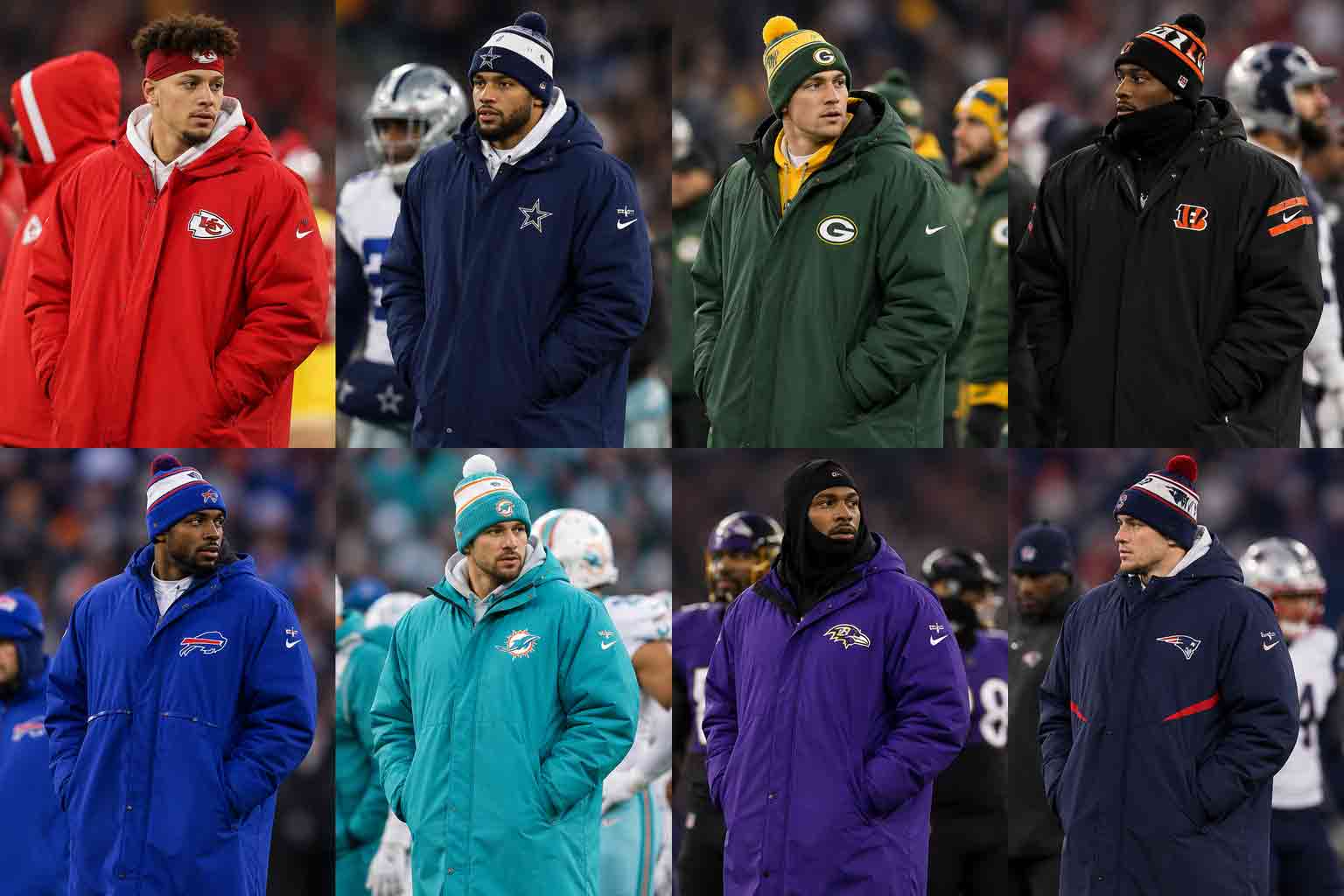
TL;DR: NFL players wear several different jacket types depending on temperature and how often they rotate on and off the field. The most iconic is the sideline cape — oversized, sleeveless, snaps on and off in seconds over shoulder pads. For milder weather, players wear fitted half-zip windbreakers that stay on during play. Insulated bombers are mostly for coaches and inactive players who stand on the sideline all game. Vests keep the core warm without restricting arm movement — popular with quarterbacks. Anoraks handle rain without heavy insulation. None of them are heated; they trap body heat from exertion, backed up by heated benches and hand warmers on the sideline.
On any given Sunday in January, you might see one player standing at the bench wrapped in what looks like a sleeping bag with a hood, while the guy next to him is in a trim half-zip pullover. A few feet away, a coach paces in a structured bomber. They’re all on the same sideline, in the same weather, wearing completely different outerwear — and that’s not an accident.
NFL sideline jackets are not just apparel. Each type serves a specific functional purpose tied to body temperature management, how quickly a player needs to get back on the field, and what position they play. Understanding the differences between them answers a question millions of fans search for every season — and reveals more about how professional athletes actually manage performance in extreme conditions than most people realize.
Why NFL Sideline Jackets Look Different From Regular Outerwear
Standard outerwear is designed for people who stay in it. You put on a winter coat, you wear it, you take it off when you’re inside. NFL players do something fundamentally different: they heat up intensely during play, return to the sideline already warm from exertion, cool down rapidly while standing still, and then have to go back onto the field and perform at maximum intensity — sometimes within two or three minutes.
This creates a specific thermal management problem. Wear too much, and you overheat or restrict movement heading back onto the field. Wear too little, and your muscles tighten up during the break, increasing injury risk. The jackets seen on NFL sidelines are engineered around this cycle, not just around ambient temperature.
The other design constraint that makes NFL sideline outerwear unusual: most of it has to fit over shoulder pads and other equipment, or come off fast enough to not delay a player returning to the field. These two requirements — large enough to wear over padding, but removable in seconds — explain why so many sideline garments look oversized or structurally unusual compared to conventional coats.
The Sideline Cape: The Most Recognizable NFL Outerwear
The piece most people are trying to identify when they search this question is the sideline cape — the large, sleeveless, wrap-style coat that looks almost like a blanket with a hood. It drapes over the shoulders and closes at the front with snaps or buttons, leaving the arms free inside a cavernous interior.
Why it’s shaped this way
The cape design solves the fundamental NFL sideline problem: it fits over full shoulder pads without requiring any adjustment to equipment, and it can be removed in roughly two seconds by unsnapping the front and shrugging it off. There are no sleeves to fight with, no zipper to locate while wearing thick gloves, no hood to untuck. A quarterback coming off a three-and-out with 90 seconds on the sideline can put it on, stay warm, and drop it without losing a beat.
How it’s constructed
Sideline capes are typically built with a nylon shell and a fleece lining to trap body heat during cold-weather games. The exterior fabric is chosen for wind resistance and water repellency rather than heavy insulation — the goal is to trap the heat the player’s body is already generating, not to add heat from outside. The viscose or fleece lining offers an added layer of warmth and comfort, while the parachute-style outer fabric provides superior resistance against wind and rain.
Length matters too. Most sideline capes extend to the knee or below, covering the thighs and upper legs — areas that cool quickly when a player sits or stands still between series. This distinguishes them from shorter jackets, which leave the lower body exposed.
Who uses it and when
Sideline capes are primarily used by active players who rotate in and out of the game — quarterbacks, wide receivers, running backs, and defensive backs. They’re also heavily used by kickers and punters, who may stand virtually idle for a full quarter at a time and have no exercise-generated warmth to rely on.
The cape is fundamentally a cold-weather tool. In mild temperatures (above 50°F), players rarely wear them. Below 40°F, they become nearly universal among skill players. In extreme cold — games at Green Bay, Buffalo, or Kansas City in January — they’re often paired with multiple base layers underneath and supplemental heat sources on the bench.
For teams exposed to cold elements year in and year out, investing in a fleece-lined version is considered worth the additional cost. For teams in warmer climates that only occasionally deal with cold weather, a non-lined version that provides wind and rain protection without the thermal lining is often sufficient.
The Sideline Windbreaker and Half-Zip Pullover
Not every sideline jacket is a cold-weather tool. On days when temperatures are mild but the wind is up, or when early October rain arrives without the cold that follows it later in the season, players and coaches wear a completely different category of outerwear: the sideline windbreaker and half-zip pullover.
Construction and purpose
These are fitted, mid-weight jackets — slim enough to wear comfortably over a uniform without the bulk of a cape, and built primarily from stretch-woven polyester with a water-repellent coating on the exterior. They’re designed for active wear: a player can have one on and return to the field without removing it, unlike a cape.
The half-zip design (a zipper running from the chest to the collar rather than the full length of the jacket) serves a specific purpose — it allows the player to regulate airflow at the neck and chest without fully opening the garment. On a 45°F day with wind, this matters more than it might seem.
Four-way stretch fabric is common in these pieces, allowing full arm extension without the jacket pulling across the back or restricting a throwing motion. Side zipper vents further adjust fit and ventilation.
When players wear these
These are primarily pregame and mild-weather garments. The sideline attire of quarterbacks during moderate temperatures consists of windbreakers and hoodies that fit neatly over uniforms — warmth is a consideration, but so is preserving full range of motion.
You’ll also see these worn heavily by coaches and sideline staff throughout games in temperate conditions. Unlike players who go on and off the field, coaches stay on the sideline for the entire game and need outerwear that functions for sustained wear without generating excessive heat.
The Insulated Bomber Jacket
The bomber jacket occupies the middle ground between a windbreaker and a full cape coat. It has sleeves — making it a wearable jacket in the conventional sense — but it’s cut with padding or a synthetic insulated fill that provides significantly more warmth than a windbreaker.
Design characteristics
A bomber sits at the waist, has ribbed cuffs and a ribbed hem, and typically uses a full-zip or snap closure. The silhouette is more structured than the cape and more form-fitting than a traditional parka. Most versions used on NFL sidelines have a quilted or padded outer shell with an insulated interior.
This design is better suited to people who stay in the jacket for extended periods — it’s not built for split-second removal like the cape. That’s why it’s most commonly worn by coaches, coordinators, team doctors, and support staff who remain on the sideline for the full game. It’s also worn by inactive players and those who know they won’t return to the field (injured players, players who’ve already been substituted out for a series).
When it appears
Bomber jackets show up prominently on NFL sidelines from late October through the end of the season. In the coldest environments, they’re sometimes layered under a cape by players who want maximum insulation.
The Vest
Sideline vests — insulated, sleeveless upper-body garments — are a newer addition to NFL sideline outerwear and have grown in visibility in recent seasons.
The logic behind the vest is specific: it delivers core warmth without restricting the arms. For players and coaches who gesticulate constantly, stretch between series, or need complete arm freedom while staying warm through the torso, a vest solves the problem that a bulky jacket creates.
The most functional versions use thermal insulation technology in the body panels while keeping the armholes completely unobstructed. They’re often paired with a long-sleeve base layer underneath, which handles arm warmth separately while the vest manages core temperature.
Vests are increasingly common on quarterbacks during cold games, particularly for passers who want to maintain arm looseness and throwing mechanics even while stationary on the sideline.
The Anorak
The anorak is a pull-on (rather than zip-up or button-down) hooded jacket with a partial zip at the neck. Its defining characteristic is that it’s put on over the head rather than opening fully — a design that provides better wind sealing at the waist and chest than a conventional front-zip jacket.
On NFL sidelines, anoraks appear most often in wet-but-not-cold conditions: early-season rain games in open-air stadiums, or warm-weather venues where precipitation arrives without the low temperatures that would call for heavier outerwear. The wind-sealing design of the anorak keeps spray and horizontal rain out better than a front-zip jacket can, since there’s no opening for wind to force open.
These are slim, lightweight pieces — not insulated, and not designed for extreme cold. Their function is moisture protection and mild wind resistance, not warmth.
How Temperature and Position Drive What Gets Worn
Watching an NFL game in December, it can look random — different players in different outerwear, no apparent consistency across a roster. In practice, there’s a logic to it.
Active players in rotation tend to wear capes or nothing at all. They generate enough body heat during series that heavy outerwear can cause overheating, and they need to remove whatever they’re wearing quickly before returning to the field. A wide receiver getting two or three plays per drive doesn’t need the same sustained warmth as someone who stands idle for 15 minutes.
Positional inactivity matters more than temperature. A kicker who only takes the field twice in a game needs more protection than a linebacker who plays half the defensive snaps — even if they’re standing in the same weather. Kickers and punters are particularly reliant on sideline outerwear because they’re less active during the game and can’t rely on exercise-generated warmth to stay comfortable.
Coaches and staff stay on the sideline the entire game without the option of generating warmth through exertion. Their outerwear choices skew toward sustained warmth — bombers, insulated vests, layered systems — rather than the quick-on, quick-off functionality that shapes player choices.
Injury and game situation also affect what’s worn. A player who’s just come out of the game for an injury or been substituted out for several series will often reach for a cape or heavier jacket that an active starter might not need.
As San Francisco receiver Kendrick Bourne has described his approach to cold-weather games: “You don’t need to wear a ton because I’m going to get hot and it could slow me down. You can always heat up. You can’t cool down. Once you’re in the game and adrenaline’s going, you’re good. But the hardest part is pregame and early on.”
The Full Cold-Weather System: Jackets Are Only Part of It
The sideline jackets seen on television are the most visible element of NFL cold-weather gear, but they function as part of a layered system rather than as standalone protection.
Base layers
Players follow basic layering principles under their outerwear, starting with compression base layers and insulated mid-layers. Depending on preference, they can add gaiters, balaclavas, beanies, socks, and gloves on top of those.
The base layer does the work the sideline jacket can’t — it sits against the skin, wicks moisture generated during play, and maintains a thin insulating barrier that keeps body heat close even when the outer layer is removed for a series.
Heated benches and supplemental warmth
Heated benches have become standard equipment for cold-weather teams. Beyond the bench surface itself, “Hot Hats” keep helmets at an appropriate temperature so players can put them on without the padding cracking in extreme cold. Foot decks blow warm air upward from below the bench.
The most popular bench heater design in the NFL uses hollowed fiberglass benches that pump heat through blowers at 170,000 BTUs, including a tray that slides out to allow warm air to fill a player’s outerwear from below.
Hand warmers appear everywhere: inside hand muffs, taped to the tops of feet before putting on cleats, placed in gloves, and taped inside the ear hole of the helmet. Players go through large quantities of these during a single cold-weather game because individual packets don’t last the full duration.
The sideline jackets, in other words, are the visible outer shell of a comprehensive thermal management approach. The jacket keeps wind and moisture out and traps body heat; the bench system maintains warmth from below; the base layers maintain warmth against the skin; the hand warmers address extremities. Each element addresses a different part of the problem.
What Fans Often Mistake for a Single Jacket Type
One source of confusion in this topic is that “sideline jacket” gets used loosely to describe several distinct garment types that look similar at broadcast distance but function very differently.
The most common mix-up is between the sideline cape and the sideline parka. Both are long, oversized, and worn in cold weather. The cape is sleeveless and wraps around the body; the parka has sleeves and insulation, and is cut longer with a larger hood. On television, they can look identical — but the operational difference (quick removal vs. sustained wear) determines which type a player reaches for.
The windbreaker and anorak are also frequently conflated. Both are lightweight and water-resistant. The difference is structural: a windbreaker opens fully at the front, while an anorak is a pull-over design. The anorak provides better wind sealing because there’s no front opening for air to penetrate.
Quick Reference: NFL Sideline Jacket Types by Function
| Jacket Type | Key Feature | Primary Use Case |
|---|---|---|
| Sideline cape | Sleeveless, oversized, snap closure | Active players who rotate; cold weather |
| Half-zip windbreaker / pullover | Fitted, stretch-woven, water-repellent | Mild weather; active wear; coaches |
| Insulated bomber | Padded, full-zip or snap, ribbed cuffs | Coaches, inactive players; sustained sideline wear |
| Vest | Sleeveless, insulated body only | Quarterbacks and players needing arm freedom |
| Anorak | Pull-over hood, partial neck zip | Wet weather without extreme cold |
Frequently Asked Questions
What are the big coats NFL players wear on the sideline called?
They’re most commonly called sideline capes or cape coats. The sleeveless, oversized design is intentional — it fits over shoulder pads and can be removed in seconds when a player returns to the field. The long cut, typically reaching the knee, keeps the thighs and upper legs warm during breaks between series.
Are the jackets NFL players wear on the sideline heated?
No. Standard sideline jackets are not electrically heated. They work by trapping the player’s own body heat using insulating linings — usually fleece or a synthetic thermal fill — combined with a wind-resistant outer shell. Supplemental warmth comes from heated benches, propane blower heaters on the sideline, and chemical hand warmers.
Why do some NFL players wear no jacket at all in cold games?
Heavily active players sometimes prefer no outerwear because they generate enough internal heat through exertion that adding a jacket would cause overheating. A player coming off the field after a physical series may be sweating despite sub-freezing temperatures. Receivers and defensive backs who run high-intensity routes every other play often go jacket-free until temperatures drop significantly.
Why do coaches wear different jackets from players?
Coaches don’t go on and off the field, so they don’t need quick-removal outerwear. Their priority is sustained warmth over multiple hours of standing or pacing, which favors fitted bombers and insulated parkas over the cape-style pieces that serve active players. Coaches also aren’t wearing shoulder pads, so fit isn’t constrained by equipment bulk.
Do kickers wear different sideline gear than other players?
Yes, in practice. Kickers and punters are the least active players on a sideline during any given game — they may take the field twice in a full game — which means they don’t generate the exercise warmth that other positions rely on. In cold weather, kickers tend to layer more aggressively and keep their cape or parka on longer than skill players who rotate frequently.
What do NFL players wear under their sideline jackets?
Compression base layers are standard — moisture-wicking tights and long-sleeve tops that sit against the skin. Over those, some players add a thermal mid-layer before the outer jacket. Extremity-specific additions include beanies, balaclavas (for the face and neck), insulated gloves, and chemical hand warmers tucked into hand muffs or taped inside gloves.
Sources: FanSided cold-weather NFL gear breakdown (January 2026); ESPN “How players prepare for the coldest games” (January 2026); ESPN “Seven ways NFL players stay warm” (December 2017); TIME Magazine “How NFL players stay warm during cold games”; Relentless Sports cold-weather NFL player guide; SportsUnlimited Fisher Sideline Cape comparison; AccuWeather “5 ways NFL athletes keep from freezing.”